
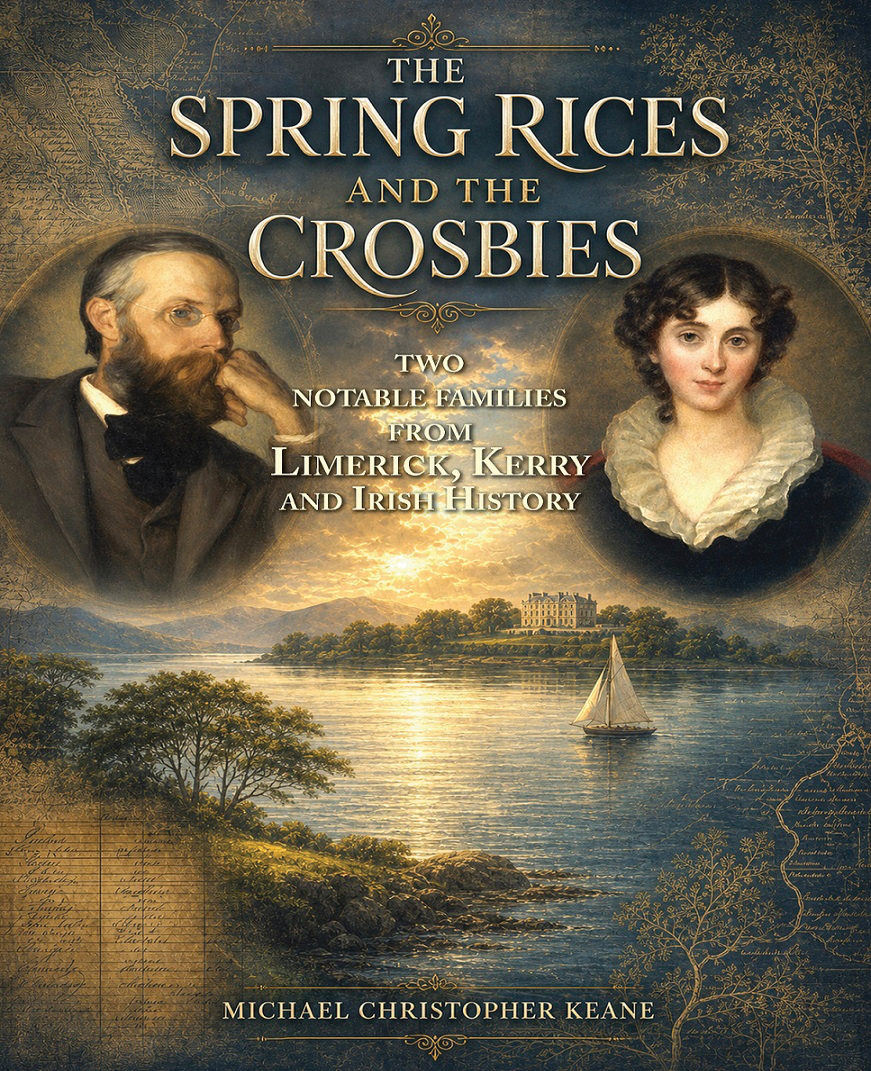
A new book on the history of the Crosbies of Ardfert Abbey and Ballyheigue Castle, along with their cousins the Spring Rices of Mount Trenchard, Foynes, has just been published by Tarbert local historian Michael Christopher Keane. Titled ‘The Spring Rices and the Crosbies, two notable families from Limerick, Kerry and Irish history’, the book is now on sale in local bookshops in Kerry and Limerick. It is also available on Amazon. This is the author’s fifth local history book which commenced with ‘From Laois to Kerry’ in 2016.
The Crosbies were a leading family of the Anglo-Irish ascendancy era in Kerry. Along with the Dennys and the Blennerhassetts, they dominated Kerry politics throughout the 18th and 19th centuries, representing the county almost continuously in Parliament, firstly in Dublin and then in Westminster, for much of that time. Some generations, such as, for example, William Talbot-Crosbie of Ardfert Abbey, or ‘Billy the Leveller’ as he came to be popularly known, were highly controversial in their time. Remarkably, William’s son Lindsey was one of the most progressive landlords of his era, being a strong supporter of both land reform and Home Rule. His colourful son Maurice, along with being a candidate for the Irish Parliamentary Party in Cork in the 1918 general election, later became a Hollywood actor. As discussed in some detail in the book, their two great houses in Kerry, Ballyheigue Castle and Ardfert Abbey, were both burned down during the War of Independence and the Civil War.
Like many large extended families of their time, the Crosbie family story contained its share of scandals. These included the shipwrecking of the Golden Lion laden with bullion at Ballyheigue, which resulted in one of Kerry’s most famous unsolved mysteries. Accusations against the Crosbies and others led to arrest, jail, alleged murder and multiple court hearings, with much manipulation of the legal system at the time. There was also a high-profile affair between Elizabeth Crosbie, wife of Reverend William Crosbie of Castleisland, and William Lamb, later the British Prime Minister Lord Melbourne 1834-1839.
The Spring Rices of Mount Trenchard of Foynes originated with a marriage between two prominent Kerry families, the Springs of Castlemaine and the Rices of Dingle. Four members of the family went on to play leading roles in local, Irish and International history. Mary Spring Rice is best known through being on board the Asgard which successfully landed a large quantity of rifles and ammunition into Howth in 1914. These ‘Mauser rifles’ then became the guns of the Easter Rising in 1916. Mary later made Mount Trenchard available as a safe house for the IRA during the War of Independence. Sadly, she died from tuberculosis in 1924. Her father, Thomas Spring Rice, the 2nd Lord Monteagle, was a co-founder of the Irish Co-operative movement and the second President of their representative body, the IAOS. It was through his efforts that the very first co-operatives were established in West Limerick before then spreading rapidly throughout the country. In politics he introduced the Irish Dominion Bill into the House of Lords at Westminster in 1920. Although defeated, it acted as a template for the subsequent Irish Treaty of December 1921.
The 1st Lord Monteagle, also Thomas Spring Rice, was elected to parliament representing Limerick in 1820. He rose through the ranks to become Chancellor of the Exchequer under Lord Melbourne 1835-1839. Later, as a member of the House of Lords, he earned a fine reputation during the horror years of the Great Famine. Another family member, Cecil Spring Rice, was a leading British diplomat who held the highly critical role of British Ambassador to the USA during World War I 1914-1918.